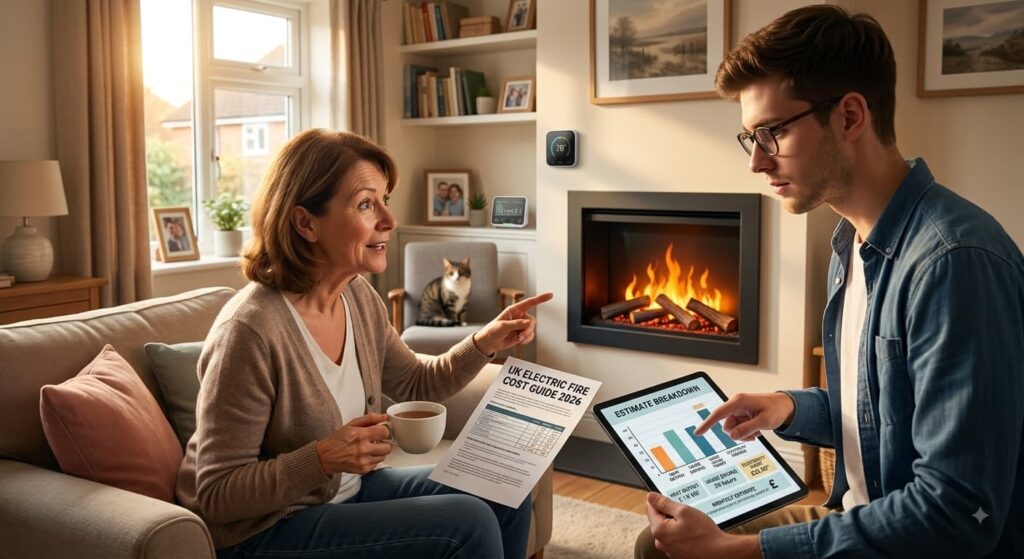
Electric fires have never been more popular in UK homes. They are stylish, safe, and easy to install, especially in modern new builds and open-plan living rooms where a traditional chimney simply is not an option. But the question that every homeowner asks before buying one is: how much does it actually cost to run an electric fire?
This complete guide breaks down the real running costs of electric fires in the UK, using the latest Ofgem energy price cap figures for 2026, so you can make a genuinely informed decision before you buy.
Understanding UK Electricity Rates in 2026

Before calculating any running costs, you need to know what electricity actually costs right now. As of 1 July 2026, Ofgem has set the electricity unit rate at 26.11p per kWh for standard variable tariff customers paying by Direct Debit in England, Scotland, and Wales. This is the figure we will use throughout this guide, though your personal rate may be slightly different depending on your region and tariff type.
If you are on a fixed-rate tariff, you may be paying less. Checking your most recent energy bill is always the best way to get your exact unit rate.
The Simple Formula for Working Out Electric Fire Running Costs
Calculating how much your electric fire costs to run is straightforward. You only need two numbers:
Cost = Power (kW) x Time (hours) x Unit rate (p/kWh)
For example:
- A 2kW electric fire running for 1 hour at 26.11p/kWh = 52.22p per hour
- A 1kW electric fire running for 1 hour at 26.11p/kWh = 26.11p per hour
- A 1.5kW electric fire running for 1 hour at 26.11p/kWh = 39.17p per hour
These are the base figures. Everything else, from thermostat settings to heat output modes, feeds into how often the fire actually draws that full wattage.
Electric Fire Running Costs at a Glance (2026 Rates)
| Fire Setting | Power Draw | Cost Per Hour | Cost Per Evening (4hrs) | Cost Per Month (4hrs/day, 30 days) |
|---|---|---|---|---|
| Flame effect only | 0.02 to 0.05 kW | Under 2p | Under 8p | Under £2.40 |
| Low heat | 0.75 kW | ~19.6p | ~78p | ~£23.50 |
| Medium heat | 1 kW | ~26p | ~£1.05 | ~£31.30 |
| High heat | 1.5 kW | ~39p | ~£1.57 | ~£47.00 |
| Full output | 2 kW | ~52p | ~£2.09 | ~£62.60 |
These figures are based on the Ofgem electricity unit rate of 26.11p/kWh (July to September 2026). Running costs will vary depending on your personal tariff, region, and how often the thermostat cuts the heater in and out.
Different Types of Electric Fire and Their Running Costs
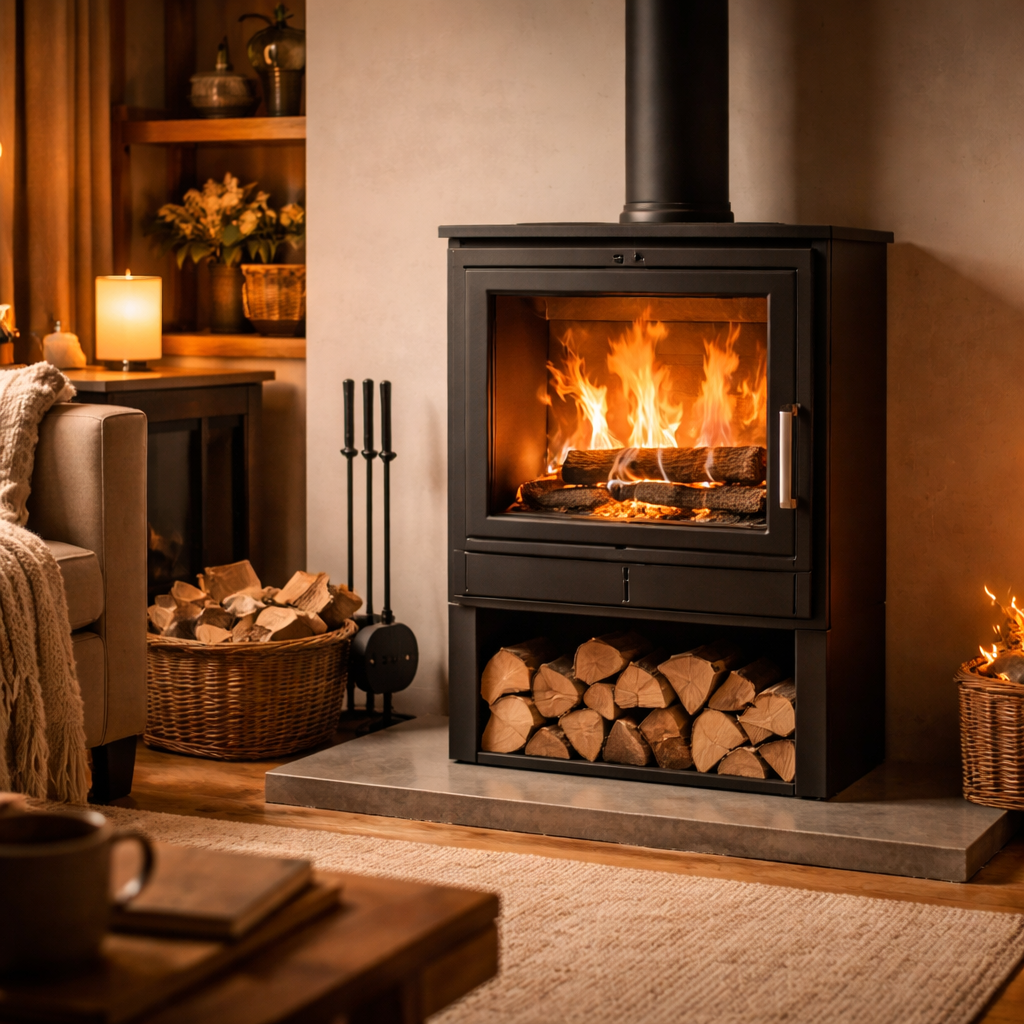
Not all electric fires are built the same. The type you choose will have a significant effect on your day-to-day running costs.
Inset Electric Fires
Inset electric fires sit flush within a wall or fireplace surround, giving a clean and built-in appearance. Most inset models run between 1kW and 2kW, making them suitable for rooms up to around 25 to 30 square metres. At full output, expect to pay between 26p and 52p per hour. These are a popular choice for media wall fireplaces and are regularly installed in Leicester living rooms where a traditional flue is not available.
Freestanding Electric Fires and Stoves
Electric stoves are designed to mimic the look of a wood-burning stove. They are typically low-wattage when used in flame-effect-only mode, often drawing just 15 watts. At full heat output of 1.5kW to 2kW, they sit in the same running cost bracket as inset fires. Because many homeowners use these for ambience rather than primary heating, monthly running costs can actually be very low.
Electric Fire Suites
An electric fire suite combines a fire insert with a surround and hearth. The fire element itself is what draws electricity, so the costs are identical to a standard inset fire of the same wattage. The surround adds no running cost whatsoever. If you are interested in how different surrounds affect the overall look and feel of your room, take a look at our guide to fireplace surround ideas for modern homes.
Hole-in-the-Wall and Media Wall Electric Fires
Wide-format electric fires designed for media walls are often higher wattage, ranging from 2kW up to around 3kW for very large models. At 3kW and 26.11p/kWh, you are looking at roughly 78p per hour at full output. However, these models nearly always feature sophisticated thermostatic controls, meaning they will not draw full power for the entire time they are switched on. They cycle on and off to maintain your chosen temperature, bringing real-world costs down considerably. You can explore some of the most popular media wall fireplace ideas to see what works in different room layouts.
How Much Does It Cost to Run an Electric Fire Per Day?
Based on an average usage pattern of around 4 hours per evening, here is what you can expect to pay per day at current Ofgem rates:
- Flame effect only: Less than 10p per day
- Low heat (0.75kW): Approximately 78p per day
- Medium heat (1kW): Approximately £1.04 per day
- Full heat (2kW): Approximately £2.09 per day
Most homeowners do not run their electric fire at full blast continuously. In practice, thermostat controls mean the heating element cuts in and out, so real-world daily costs for a well-insulated room typically fall somewhere between the medium heat and full heat figures.
How Much Does It Cost to Run an Electric Fire Per Month?
For winter months when you are likely to use your fire most, running costs look like this based on 4 hours of use per day over a 30-day month:
- Flame effect only: Under £2.40 per month
- Low heat (0.75kW): Around £23.50 per month
- Medium heat (1kW): Around £31.30 per month
- Full heat (2kW): Around £62.60 per month
Over a full heating season of 5 months (October through February), full-heat usage could cost between £117.50 and £313 per year, depending on the wattage and thermostat behaviour. This compares favourably to using central heating for a single room, where you are also heating hallways, bedrooms, and other areas you may not be using.
How Much Does It Cost to Run the Flame Effect Only?

This is one of the most overlooked advantages of electric fires. The flame effect, produced by LED lighting or a combination of LEDs and mirrors, typically consumes just 15 to 50 watts. At 26.11p/kWh:
- 15W flame effect for 4 hours = 0.06 kWh = under 2p per evening
- 50W flame effect for 4 hours = 0.2 kWh = around 5p per evening
This means you can enjoy the visual warmth and ambience of a flickering fire for the equivalent of leaving a small LED light on. During spring and autumn when you want the look of a fire without extra heat, this is an extremely cost-effective option. It is one of the key reasons electric fires are discussed in our guide to low-maintenance fireplaces for busy families.
Electric Fire vs Gas Fire Running Costs
One of the most common questions homeowners ask is whether electric or gas is cheaper to run. Here is a direct comparison at current 2026 energy rates:
| Fuel Type | Unit Rate (July 2026) | 2kW output cost per hour | Annual cost (4hrs/day, 5 months) |
|---|---|---|---|
| Electricity | 26.11p/kWh | ~52p | ~£313 |
| Gas | 7.33p/kWh | ~17p (at 2kW output) | ~£103 |
Gas is cheaper to run per kWh, there is no getting around it. However, gas fires carry additional costs that electric fires do not:
- Annual servicing by a Gas Safe registered engineer, typically £60 to £120 per year
- Installation costs, which require professional fitting and often flue or liner work
- No flame-only mode, meaning you cannot enjoy the visual effect without burning gas
Electric fires, on the other hand, need no servicing, no engineer visits, and can often be installed by a competent DIYer in a matter of hours. For a detailed breakdown of how these two fuel types stack up across all criteria, read our full electric fire vs gas fire comparison guide.
Electric Fire vs Central Heating: Which is Cheaper for One Room?
Running gas central heating for an entire house costs roughly 7.33p per kWh for the gas, but your boiler, radiators, and pipework are all firing up simultaneously. If you are only using one room in the evening, zone heating with an electric fire can be more economical.
The calculation depends heavily on:
- How many radiators your central heating heats when switched on
- The efficiency of your boiler
- Whether you have a smart thermostat that can truly zone single rooms
For a single living room in the evening, a 1kW to 1.5kW electric fire running for 4 hours costs between 104p and 157p. If your central heating heats 8 radiators to achieve the same result in that one room, the economics shift quickly in favour of the electric fire.
7 Key Factors That Affect Electric Fire Running Costs
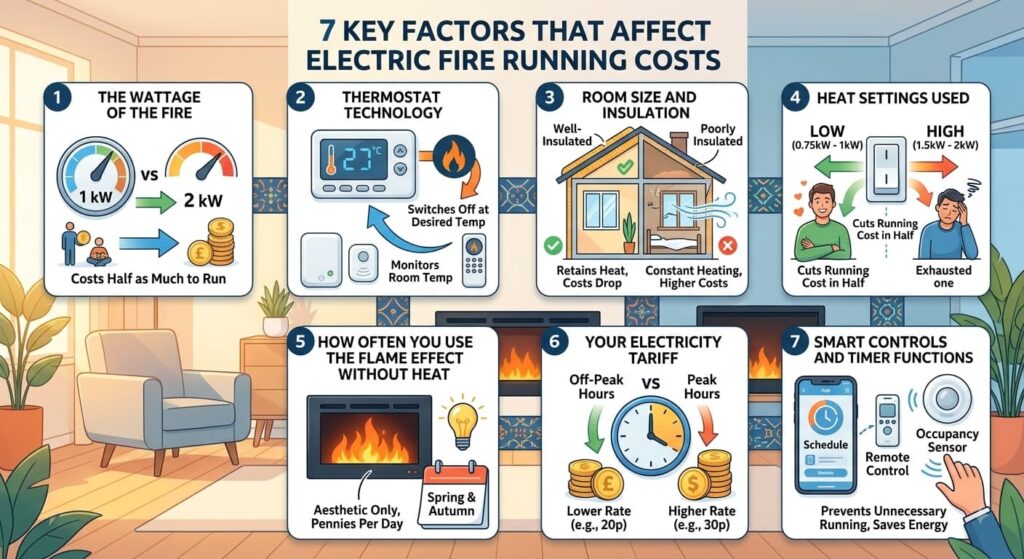
1. The Wattage of the Fire
The single biggest factor. A 1kW model costs exactly half as much to run at full power as a 2kW model. Always check the product specification before buying.
2. Thermostat Technology
Modern electric fires with thermostatic controls monitor room temperature and switch the heating element off when the desired temperature is reached. A fire with a good thermostat will rarely run at full wattage continuously, significantly reducing real-world running costs. This is one of the features to look for when choosing the right fireplace for your room size.
3. Room Size and Insulation
A well-insulated room will retain heat far more effectively. Once your room reaches temperature, the thermostat will cut the heater out, and costs drop sharply. A poorly insulated or draughty room forces the heating element to work constantly. Proper loft insulation, double glazing, and draught-proofing all reduce the cost of running any heating appliance, including electric fires.
4. Heat Settings Used
Most electric fires offer at least two heat settings. Running on the lower setting (typically 0.75kW to 1kW) rather than the maximum (1.5kW to 2kW) cuts your running cost in half. Many homeowners find the lower setting perfectly adequate for an already-warm room in mild weather.
5. How Often You Use the Flame Effect Without Heat
As discussed above, running the flame effect alone costs pennies per day. Homeowners who use the flame effect mode during spring and autumn months dramatically reduce their annual running costs while still enjoying the aesthetic.
6. Your Electricity Tariff
Economy 7 and time-of-use tariffs can offer off-peak rates well below the standard 26.11p/kWh cap. If you tend to use your fire in the evening and your tariff has a lower evening rate, your actual costs could be meaningfully lower than the figures in this guide.
7. Smart Controls and Timer Functions
Timers that turn the fire off automatically after a set period prevent it running unnecessarily. Smart home integration allows some models to respond to occupancy sensors or be controlled remotely via an app, ensuring you never pay for heating an empty room.
Are Electric Fires 100% Efficient?

Yes. Every unit of electricity an electric fire draws is converted into heat within the room. There is no flue, no combustion, and no heat lost up a chimney. This is why electric fires are described as 100% efficient at the point of use.
This is different from gas fires, where some heat is always lost through the flue, and from wood-burning stoves, where chimney losses depend heavily on the stove design, draw, and fuel quality. If you want to understand the full efficiency picture across different fuel types, our guide on energy-efficient fireplaces in Leicester covers the topic in more depth.
It is worth noting that the carbon intensity of the electricity grid still means gas produces fewer carbon emissions per unit of useful heat in most UK homes. However, as the grid continues to decarbonise, this gap is closing rapidly.
The True Cost of Ownership: Running Costs Are Only Part of the Picture
When comparing electric fires to other options, running costs per hour are important, but they are only one piece of the financial picture. Here is a full cost-of-ownership breakdown:
| Cost Category | Electric Fire | Gas Fire | Wood Burning Stove |
|---|---|---|---|
| Purchase price | £300 to £2,000+ | £500 to £3,000+ | £600 to £3,000+ |
| Installation cost | £0 to £300 | £800 to £2,000+ | £1,000 to £3,000+ |
| Annual servicing | £0 | £60 to £120 | £60 to £150 (chimney sweep) |
| Fuel cost per hour | 26p to 52p | 14p to 22p | Variable |
| Chimney/flue required | No | Usually yes | Yes |
For homeowners in new builds or properties without a chimney, the installation cost difference alone can make electric the most sensible choice financially. Our guide to fireplace ideas for new homes without a chimney goes into much more detail on this.
Tips to Reduce the Cost of Running Your Electric Fire
Use the thermostat, not the heat settings. Set your desired room temperature and let the thermostat manage the heating element. This is always more economical than running on high continuously.
Combine with a programmable timer. Set the fire to come on 20 minutes before you use the room and switch off automatically. Many homeowners find this saves significantly compared to leaving the fire running throughout the evening.
Use flame effect only in mild weather. Between March and October, most living rooms do not need supplemental heat in the evening. Running the flame effect only gives you the atmosphere for almost nothing.
Match fire wattage to room size. Oversizing your fire means you end up running on low settings constantly, or letting the thermostat cycle repeatedly. Our team at Blue Oak Fireplaces can help you choose a model properly matched to your space. Visit our fireplace showrooms in Leicester to see working models and get expert advice.
Consider your tariff. If you use your fire predominantly in the evening, a time-of-use tariff with cheaper off-peak rates could meaningfully reduce your annual costs.
Insulate the room properly. No fireplace guide would be complete without emphasising this. Good insulation reduces how hard any heating appliance works. It is the single most effective way to reduce heating costs across your whole home.
Should You Buy an Electric Fire in 2026?
Electric fires remain an excellent choice for many UK homeowners, particularly those in new builds, flats, or properties without an existing chimney. They are the cheapest fireplace to install, the easiest to maintain, and the most flexible in terms of where they can go.
Running costs are higher per kWh than gas, but when you factor in zero installation complexity, zero annual servicing costs, and the ability to use the flame effect for pennies per hour, they represent excellent value for many households.
If you are using the fire as a primary heating source for long periods in a large room, gas or a wood-burning stove may offer lower running costs. But for supplemental heating, ambience, and zone heating in a single room, electric fires are hard to beat.
You can explore some of the best electric fires available in the UK on our site, or visit our showroom to see them in person.
Frequently Asked Questions
How much does it cost to run an electric fire for 1 hour in the UK?
At the current Ofgem electricity rate of 26.11p per kWh (July to September 2026), a 1kW electric fire costs approximately 26p per hour to run at full output. A 2kW electric fire costs approximately 52p per hour. Running the flame effect only, without any heat, typically costs under 2p per hour.
Is it cheaper to run an electric fire or gas central heating for one room?
For a single room in the evening, an electric fire can be cheaper than running gas central heating across the whole house. A 1kW electric fire running for 4 hours costs roughly £1.04. If your central heating simultaneously heats other rooms you are not using, the electric fire can work out more economical. For heating an entire home over a long period, gas central heating generally wins on running cost per kWh.
Do electric fires use a lot of electricity?
Most electric fires are rated between 1kW and 2kW, which is similar to a kettle or a small electric shower. They do not use a disproportionate amount of electricity compared to other common household appliances. Modern models with thermostats also cycle on and off rather than running continuously, further reducing actual consumption.
Is it expensive to leave an electric fire on all day?
Running a 2kW electric fire at full output for 8 hours would cost approximately £4.18 at current rates. In practice, thermostat controls mean it would not run at full output continuously, so real costs are lower. That said, electric fires are best used for zone heating over shorter periods rather than as an all-day whole-home heating solution.
Can I run just the flame effect on my electric fire without the heat?
Yes. Almost all modern electric fires allow the flame effect to operate independently of the heating element. The LEDs that create the flame effect typically consume just 15 to 50 watts, costing a few pence per evening at most. This is one of the standout advantages of electric fires over gas or solid fuel alternatives.
How does an electric fire’s running cost compare to a wood-burning stove?
Wood-burning stoves can be very cheap to run if you have access to free or low-cost seasoned wood. If you are buying kiln-dried logs at retail prices, the cost per hour can be comparable to or higher than an electric fire. Stoves also require annual chimney sweeping, which typically costs £60 to £150. You can read more about the full picture in our gas vs wood-burning fireplaces guide.
Are electric fires cheaper to run than storage heaters?
Storage heaters typically charge on Economy 7 off-peak electricity rates overnight, which can be as low as 7p to 10p per kWh, making them cheaper to run per unit of heat than an electric fire on a standard tariff. However, electric fires give you instant, responsive heat exactly when you want it, with none of the scheduling constraints of storage heaters. If you have a time-of-use tariff with cheap evening rates, the cost gap narrows considerably.
What is the cheapest type of electric fire to run?
The most cost-effective electric fires to run are those with a lower maximum wattage (1kW rather than 2kW), accurate thermostats that avoid overheating the room, and efficient LED flame effect technology. Inset fires and wall-mounted fires tend to be well-matched to the room sizes they are designed for. Our team can help you find the right model for your space at our Leicester fireplace showroom.
Do electric fires need servicing?
No annual servicing is required for electric fires. Unlike gas fires, which must be checked by a Gas Safe registered engineer every year, or wood-burning stoves that need annual chimney sweeps, electric fires are largely maintenance-free. Occasionally cleaning the glass and checking the power cable is all that is typically needed. This is one of the reasons they are so popular with busy households.
Will running an electric fire add a lot to my electricity bill?
Using a 1.5kW electric fire for 4 hours per evening over a 5-month heating season would add approximately £235 to your annual electricity bill at current rates. This is based on continuous use at full output, which in practice is reduced by thermostat cycling. Many homeowners find this a reasonable cost for the combination of supplemental heat, ambience, and the flexibility that an electric fire provides, particularly when offset against the zero installation and servicing costs.
Running cost figures in this guide are based on the Ofgem electricity unit rate of 26.11p per kWh, effective 1 July to 30 September 2026. Your actual costs may vary depending on your tariff, region, and usage patterns. Always check your energy bill for your personal unit rate.
Blue Oak Fireplaces is a specialist fireplace showroom based in Syston, Leicester. We supply and install electric fires, gas fires, wood-burning stoves, and media wall fireplaces across Leicester and the surrounding areas. Visit our showroom or browse our range online to find the right fire for your home.