
Do electric fires need ventilation? It is one of the most frequently asked questions by homeowners who are considering an electric fire for the first time, and the answer is slightly more nuanced than a simple yes or no.
The short answer is this: electric fires do not require a flue, a chimney, or any dedicated ventilation system for combustion gases, because they produce no combustion gases at all. However, that does not mean ventilation is irrelevant. Every electric fire needs adequate airflow around the appliance to prevent overheating of its internal components, and some installation types, particularly media wall electric fires and inset models set into a recess, require careful planning to ensure sufficient airflow is maintained.
This guide covers everything a UK homeowner needs to know about electric fire ventilation in 2026. We explain why electric fires do not need flues, what airflow requirements they do have, how different installation types affect ventilation needs, what UK regulations apply, and what practical steps you need to take to install your electric fire safely and correctly.
Why Electric Fires Do Not Require a Flue or Chimney

To understand why electric fires have no flue requirement, it helps to understand why gas fires and wood burning stoves do.
Gas fires, solid fuel stoves, and open fireplaces all involve combustion: a chemical reaction that burns fuel and produces waste gases, including carbon dioxide, water vapour, and potentially carbon monoxide if combustion is incomplete. These gases must be safely removed from the room and expelled outside through a flue, chimney, or balanced flue system. Without this ventilation route, combustion gases would accumulate indoors, creating a serious health and safety hazard.
Electric fires involve no combustion whatsoever. They use an electrical heating element to convert electricity into heat, and an LED or optical system to create the flame effect. The only by-products are warm air (which stays in the room as useful heat) and a small amount of heat from the electronic components themselves. There are no combustion gases, no carbon monoxide risk from the appliance itself, and no requirement for any form of flue or external ventilation ducting.
This is one of the most significant practical advantages of electric fires for UK homeowners. Because no flue is needed, an electric fire can be installed in virtually any room, including bedrooms, apartments, basement rooms, conservatories, and rooms on upper floors where running a flue to the outside would be impractical or very expensive. There is no need for a chimney breast, no requirement for a HETAS-registered installer, and no Gas Safe registration necessary.
At Blue Oak Fireplaces, our electric fires range spans inset models, wall-mounted fires, freestanding electric stoves, and wide-format media wall electric fires, all of which share this no-flue advantage. Whether you have an existing chimney breast or a completely flat wall to work with, an electric fire can be installed without any structural ventilation work.
What Ventilation Do Electric Fires Actually Need?
While electric fires do not need flues or external ventilation for combustion gases, they do have ventilation requirements of a different kind: airflow around and through the appliance to prevent overheating.
Every electric fire contains electronic components, a heating element, and often a fan motor. All of these generate heat during operation. If this internally generated heat cannot dissipate adequately, component temperatures rise, triggering the appliance’s thermal cut-out protection or, in worst-case scenarios, causing premature failure or damage.
The specific ventilation requirements for an electric fire fall into two categories:
Appliance clearance distances. Every electric fire has manufacturer-specified minimum clearance distances that must be maintained between the appliance and surrounding surfaces, including the wall behind it, the ceiling or shelf above it, adjacent cabinetry or furniture, and the floor below freestanding models. These clearances ensure that warm air expelled by the appliance (typically through vents on the top, front, or sides depending on the model) can escape and disperse rather than recirculating and causing overheating.
Room airflow. The room itself must have adequate general ventilation so that the warm air expelled by the electric fire can circulate and not cause localised overheating around the appliance. In a normally ventilated living room with standard air exchange through windows, doors, and natural building infiltration, this is never a concern. It becomes relevant only in very small, completely sealed rooms with no air exchange whatsoever, which are extremely unusual in typical UK homes.
Neither of these requirements involves installing a dedicated ventilation system, fitting air bricks, or making structural modifications. Following the manufacturer’s installation instructions regarding clearance distances is all that is required in the vast majority of cases.
UK Regulations and Electric Fires: What Applies?
Understanding which UK regulations apply to electric fires (and which ones do not) helps homeowners install with confidence and avoids unnecessary concerns.
Building Regulations Approved Document J
Approved Document J of the UK Building Regulations covers combustion appliances and fuel storage. It sets out requirements for hearths, fireguards, air supply, flues, and related matters for gas fires, solid fuel stoves, and oil-fired appliances. Because electric fires are not combustion appliances, the requirements within Approved Document J do not apply to them. You do not need to worry about Approved Document J ventilation or air supply provisions when installing an electric fire.
Building Regulations Part P (Electrical Safety)
Part P of the Building Regulations does apply to electric fires, specifically when the installation involves electrical wiring work rather than simply plugging an appliance into an existing socket. If your electric fire requires a new dedicated circuit, involves hardwiring into the household electrical system (removing the plug and connecting directly to a fused connection unit), or requires new cable routes through walls or ceilings, this work must either be carried out by a Part P-registered electrician or notified to your local building control authority.
Simply plugging a standard electric fire into an existing BS 1363 socket outlet (the standard UK three-pin socket) does not require notification under Part P. Most freestanding and wall-mounted electric fires are designed for plug-and-play installation in this way.
For media wall electric fire installations that involve new wiring, structural changes to the wall, or hardwired connections, engaging a qualified electrician registered with NICEIC, NAPIT, or ELECSA is always the recommended approach.
Electrical Equipment (Safety) Regulations 2016
Any electric fire sold in the UK must carry a UKCA mark (or CE mark for products placed on the market before the UK’s exit from the EU single market), confirming that the appliance has been independently tested and certified to meet minimum safety standards covering insulation, wiring, temperature limits, and electrical integrity. When purchasing from a reputable UK retailer like Blue Oak Fireplaces, this compliance is guaranteed across every product we stock.
Carbon Monoxide Alarm Requirements
Since October 2022, Building Regulations in England require a carbon monoxide alarm in any room containing a fixed combustion appliance, such as a gas fire or a wood burning stove. Electric fires are not combustion appliances, so this requirement does not apply to rooms that contain only an electric fire. However, fitting a carbon monoxide alarm in any room where there is any gas appliance nearby (such as a gas central heating boiler in an adjacent utility room or an open gas fire in the same space) remains good practice and is strongly recommended.
For a full overview of all relevant regulations for different fireplace types, read our guide on how long does a fireplace last which covers regulatory compliance across gas, electric, and solid fuel appliances.
Ventilation Considerations by Electric Fire Type
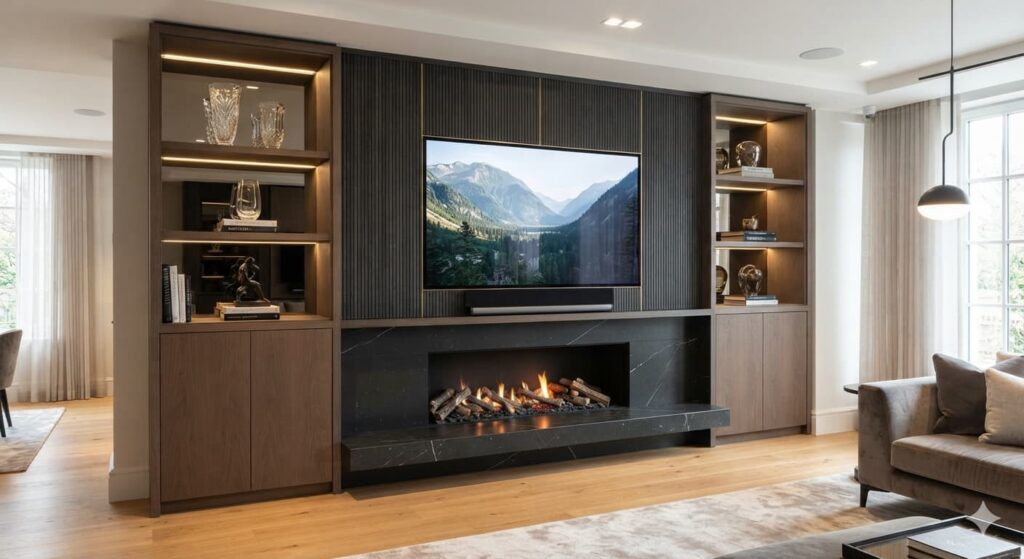
The specific ventilation and clearance requirements of an electric fire vary depending on the type of installation. Here is a detailed breakdown for each major installation type.
Freestanding Electric Fires and Electric Stoves
Freestanding electric fires and electric stoves designed to look like wood burning stoves are the simplest installation type from a ventilation perspective. Because they stand independently in the room without being built into a wall or recess, airflow around all sides of the appliance is naturally available.
The key requirements for freestanding electric fires are:
Maintain the minimum clearance distance from the rear of the appliance to the wall behind it. Most manufacturers specify 100 mm to 200 mm of clear space at the back. This allows the appliance’s heat dissipation vents to work effectively without restriction.
Keep the area directly above the appliance clear of shelves, mantelpieces, or other surfaces that could trap rising warm air from the top of the unit. Most manufacturers specify a minimum clear height of 100 mm to 300 mm above the top of the appliance.
Keep combustible materials (curtains, furniture, paper, soft furnishings) at the distances specified in the manufacturer’s instructions. This is primarily a fire safety clearance requirement rather than a ventilation requirement, but it is equally important.
Do not block the heat outlet vents. Most freestanding electric fires expel warm air through vents on the top or front of the appliance. These should never be covered, and objects should not be placed on top of a fire that vents upward.
Inset Electric Fires in a Fireplace Opening
Inset electric fires designed to sit within an existing fireplace opening or a purpose-built recess are a very popular choice for UK homes, particularly those with an existing chimney breast where a gas or solid fuel appliance has previously been removed.
Ventilation requirements for inset electric fires are slightly more demanding than for freestanding models because the appliance is partially enclosed by the surrounding recess structure. Key considerations include:
The recess dimensions must match or exceed the manufacturer’s minimum specified cavity size. A recess that is too narrow or too shallow will restrict airflow around the appliance and may cause overheating. Always check the manufacturer’s minimum recess dimensions before purchasing or building the opening.
The appliance’s heat outlet direction matters for inset installations. Most inset electric fires are designed to expel warm air forward into the room (front venting), which works well in a recess because the heat exits toward the open room rather than into the enclosed cavity. Some models vent upward, which requires a gap or channel above the unit for the warm air to escape.
An existing chimney recess that is being sealed off following the removal of a gas fire or stove must be handled correctly. Any sealed chimney breast should have ventilation bricks or permanent air vents fitted to prevent damp from condensation within the redundant flue. These are not ventilation requirements for the electric fire itself but for the masonry structure behind it.
If you are fitting an inset electric fire into a recently vacated fireplace opening that previously held a gas fire, always confirm with a Gas Safe registered engineer that the gas supply has been properly capped and that any residual gas appliance requirements (such as mandatory ventilation for open-flued gas appliances) no longer apply to the space.
Wall-Mounted Electric Fires
Wall-mounted electric fires sit proud of the wall surface and are secured to the wall with brackets, leaving the back of the appliance in contact with or close to the wall. Ventilation requirements for wall-mounted models are generally straightforward.
Most wall-mounted electric fires require a small gap (typically 20 mm to 50 mm) between the rear of the appliance and the wall surface to allow cooling air to circulate. This gap is usually accommodated by the mounting bracket system provided with the appliance.
The area above the appliance must be kept clear to the distance specified by the manufacturer. This is particularly relevant when a wall-mounted electric fire is positioned below a television, a floating shelf, or other fixed items. Many modern electric fires are specifically designed for use below a TV and have front-venting heat outlets that direct warm air away from the electronics above rather than upward. If you are planning to mount a television above an electric fire, always check the manufacturer’s stated clearance distance between the top of the fire and the base of the TV.
Combustible materials, including wall panelling, fabric wall coverings, and decorative items, must be kept at the distances stated in the manufacturer’s instructions.
Inset Electric Fires in a Media Wall
Media wall installations are currently the most popular choice for electric fires in UK living rooms, and they present the most important ventilation planning requirements of any electric fire installation type.
A media wall is typically constructed from timber stud framing faced with plasterboard, with a recessed cavity built specifically to house the electric fire. Because the appliance is enclosed on three or four sides by the stud wall cavity, the potential for heat accumulation around the appliance is greater than in other installation types. Getting the ventilation right during the design and build stage is essential.
Key ventilation considerations for media wall electric fire installations include:
Choose the fire before building the wall. This is the most important planning step of all. The dimensions of the fire’s required recess, including the specified depth, width, height, and minimum clearances on all sides, must be known before the stud wall frame is constructed. Building the media wall first and then trying to fit a fire into it is a common and costly mistake. Always select the exact model and check its installation datasheet first. At Blue Oak Fireplaces, our team advises on this as a standard part of any media wall consultation.
Match the cavity to the manufacturer’s specification. The recess must be built to the exact or slightly larger dimensions specified by the manufacturer. Insufficient depth is one of the most common installation errors and can restrict rear or side airflow to the point of causing overheating. Many media wall electric fires require a cavity depth of 150 mm to 300 mm depending on the model.
Consider heat outlet direction when planning the TV position. Electric fires that vent upward may require a gap or channel above the fire within the media wall structure to allow warm air to escape before it reaches any shelving or the television above. Fires with front-venting heat outlets push warm air directly into the room, which is more TV-friendly because it does not direct heat upward toward the screen. Always check the heat outlet direction on the specific model before finalising the media wall design.
Do not share the fire cavity with AV equipment. Some homeowners plan a media wall with the fire and the AV equipment (streaming devices, games consoles, amplifiers) in close proximity or in the same cavity section. This is inadvisable. AV equipment generates its own heat and requires its own ventilation. Mixing it with the electric fire cavity can cause both the fire and the electronics to overheat. Keep the fire in its own ventilated cavity, and house AV equipment in separate ventilated sections of the media wall.
Allow for ventilation channels within the stud frame. For upward-venting electric fires, plan ventilation channels or gaps within the media wall structure that allow warm air to rise and exit from the top of the cavity. Some media wall builders fit grilles at the top of the fire recess for this purpose, which can be positioned discreetly within the overall design.
Use fire-resistant materials around the fire cavity. The stud framing and plasterboard immediately surrounding the fire cavity should be specified using fire-resistant (FR) grade materials, particularly around the fire itself. This is both a regulatory requirement where structural work is involved and a safety best practice for any media wall with an electric fire.
You can explore our full range of electric fires suited for media wall installations on our media walls page. We carry models specifically designed for recessed media wall fitting, with front-venting heat outputs, built-in overheat protection, and installation datasheets that specify exact clearances.
Overheating Protection in Modern Electric Fires

Most modern electric fires include built-in thermal cut-out protection as a standard safety feature. This system automatically cuts power to the heating element if the internal temperature of the appliance exceeds a safe threshold, preventing damage to the appliance and eliminating the risk of overheating-related hazards.
While this is a reassuring safety net, it should not be treated as a substitute for correct installation with proper clearances. An electric fire that regularly triggers its thermal cut-out is one that has been installed without adequate airflow. Repeated thermal cut-outs indicate an installation problem that should be corrected by adjusting the clearances around the appliance, not ignored.
When selecting an electric fire for any installation type, particularly a media wall, look for:
Built-in thermal cut-out protection as a standard feature. This is present in virtually all reputable modern appliances but worth confirming in the product specification.
Cool-touch exterior surfaces. Many quality electric fires are designed so that the outer casing remains cool during operation, making them safer in homes with children and pets and reducing the heat load on surrounding surfaces.
Front-venting heat design for media wall and TV-adjacent installations. This specifically prevents warm air from being directed upward toward electronics or combustible materials above the appliance.
Overheat protection with automatic restart. Some premium models shut down automatically if overheating is detected and restart automatically once the internal temperature returns to a safe level, rather than requiring a manual reset.
Ventilation for the Room: Is It Necessary?
One question homeowners sometimes raise is whether the room itself needs additional ventilation when an electric fire is installed. The answer, in almost all circumstances, is no.
Unlike gas fires rated above a certain output (which require permanently open air vents in the room under UK Building Regulations), electric fires have no combustion air requirement. They do not consume the oxygen in a room and do not produce carbon monoxide or other combustion gases that need to be diluted by fresh air.
A normal UK living room with standard window and door air infiltration has more than enough natural air exchange to dissipate the warm air produced by a 1 to 2 kW electric fire without any ventilation-related concerns.
The only scenario in which room ventilation might be considered is a very small, very tightly sealed room with minimal air exchange and poor thermal mass. Even in this case, the concern would be the room becoming uncomfortably warm from the electric fire output rather than any air quality or safety issue, and the solution would simply be to open a window or reduce the fire’s heat setting.
Practical Safety Checklist for Electric Fire Installation
Regardless of the installation type you are planning, running through this checklist before and during installation will help ensure your electric fire is both safe and compliant.
Before installation, read the manufacturer’s installation instructions and note the specified minimum clearances for the top, sides, rear, and front of the appliance. These vary between models and must not be assumed.
Confirm that your existing electrical circuit can accommodate the appliance’s power draw. A standard 2 kW electric fire draws approximately 8.7 amps, which is within the rating of a standard 13-amp socket circuit. If you are connecting multiple high-draw appliances to the same circuit, consult a qualified electrician.
For hardwired installations or any new electrical wiring, engage a Part P-registered electrician (NICEIC, NAPIT, or ELECSA registered) to carry out the work. This ensures compliance with Building Regulations and provides you with an electrical installation certificate.
For media wall installations, select the electric fire before designing and building the stud wall, and share the appliance’s installation datasheet with your builder or contractor so they can build the recess to the correct dimensions.
Confirm the heat outlet direction of the appliance and plan the surrounding structure and the position of TVs, shelving, and other items accordingly.
Ensure the appliance carries a UKCA or CE mark confirming it has been independently safety tested.
Keep the area around the appliance clear of combustible materials (curtains, furniture, paper, soft furnishings) to the distances specified in the manufacturer’s instructions.
Never cover or obstruct the heat outlet vents of the appliance during operation.
Fit a carbon monoxide alarm in any room that also contains a gas appliance, even if the gas appliance is not the fire itself.
Register the appliance with the manufacturer on purchase to validate any warranty and ensure you are notified of any safety recalls.
Electric Fires vs Gas Fires: Ventilation Comparison
For homeowners weighing up the choice between an electric fire and a gas fire, the ventilation requirements represent one of the clearest practical differences between the two appliance types.
A gas fire requires either an appropriate chimney or flue for an open-flued installation, or a purpose-built balanced flue terminal through an external wall for a balanced flue model. Open-flued gas fires in rooms above a certain size also require permanent air vents to supply combustion air. All gas fire installations must be carried out by a Gas Safe registered engineer, and the appliance must be serviced annually by a Gas Safe engineer to remain safe and legal.
An electric fire requires none of these things. No flue, no air vents, no Gas Safe engineer, and no annual mandatory servicing (though an occasional inspection is still good practice for any appliance). Installation can be as simple as positioning the fire and plugging it in to an existing socket, or as involved as a full media wall build with hardwired connections, all without any specialist heating engineer involvement.
For homes without an existing chimney or flue, the cost and disruption difference between installing a gas fire (which requires a new balanced flue penetration through an external wall) and an electric fire (which requires no structural work for the heating element) can be very significant.
You can explore the full comparison of electric and gas fire options in our gas fires range and electric fires range at Blue Oak Fireplaces, and read our guide to modern fireplace ideas for UK homes for broader design inspiration before you decide.
Why Choose Blue Oak Fireplaces for Your Electric Fire?

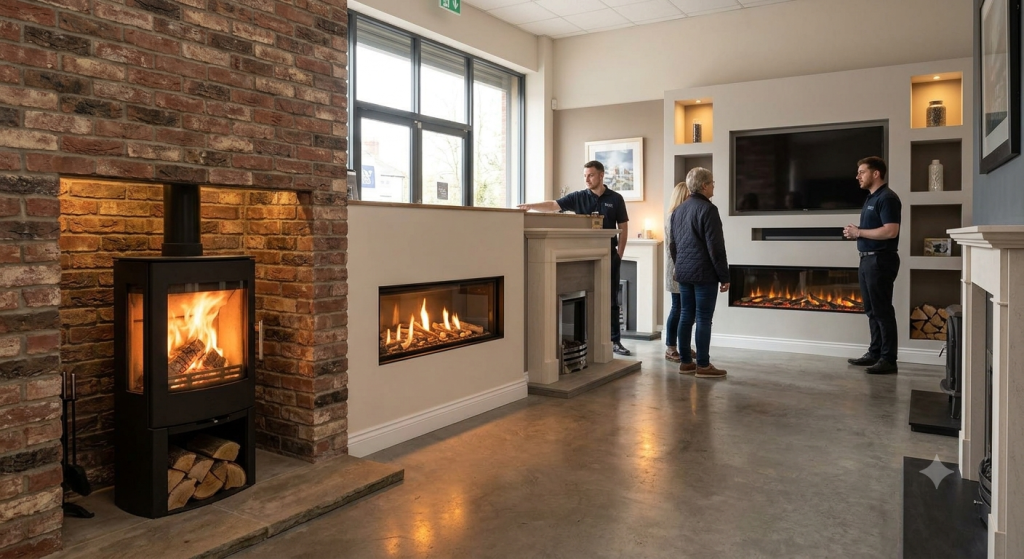
At Blue Oak Fireplaces, we have been supplying and installing electric fires across Leicester and the Midlands for over decades now. Our three-storey showroom at 1159 Melton Road, Syston, Leicester is one of the largest fireplace showrooms in the region, with live electric fire displays across wall-mounted models, inset fires, freestanding electric stoves, and wide-format media wall fires.
Every electric fire we stock is UKCA-compliant and sourced from manufacturers with proven safety and quality track records. Our team can advise on the right appliance for your room, your wall type, and your installation plans, and will go through the manufacturer’s ventilation and clearance requirements with you so you can install with complete confidence.
We also carry a full range of fireplace surrounds and accessories to complete the look of your new electric fire installation, and our media walls section covers everything you need for a full media wall installation from fire selection through to the finished wall specification.
For homeowners comparing electric fires with other options, you might also find our guides to wood burning stoves and how long a fireplace lasts helpful before making your final decision.
Visit us at 1159 Melton Road, Syston, Leicester, LE7 2JS, or call our team on +44 116 373 4193 to book a showroom visit or speak with one of our specialists today.
Frequently Asked Questions
Do electric fires need ventilation?
Electric fires do not need ventilation in the same way that gas fires or wood burning stoves do. They produce no combustion gases, so no flue, chimney, or external air vent is required. However, all electric fires do need adequate airflow around the appliance itself to prevent overheating of internal components. This means following the manufacturer’s specified minimum clearance distances between the appliance and surrounding walls, ceilings, shelves, and furniture. For media wall installations, careful planning of the recess dimensions and heat outlet direction is also necessary to ensure sufficient airflow within the cavity.
Do electric fires need a flue?
No. Electric fires do not need a flue of any kind. Because they burn no fuel and produce no combustion gases, there is nothing to vent outside. This is one of the most practical advantages of electric fires over gas fires and wood burning stoves, which both require a suitable flue or chimney. An electric fire can be installed in any room in your home, including apartments, upper floor rooms, and rooms with no existing chimney, without any structural ventilation work.
Do I need an air vent for an electric fire?
No. Building Regulations do not require a permanent air vent in a room solely because it contains an electric fire. Air vent requirements under Approved Document J apply to combustion appliances such as gas fires and solid fuel stoves, which consume oxygen from the room during burning. Electric fires do not combust anything and do not deplete the room’s oxygen supply. Standard natural ventilation in a normally occupied UK living room is entirely adequate for any electric fire.
Can an electric fire be installed without a chimney?
Yes, and this is one of the most common reasons UK homeowners choose electric fires. Because no flue or chimney is required, an electric fire can be installed in any room regardless of whether the property has a chimney, a chimney breast, or any pre-existing fireplace infrastructure. Homes without chimneys that could not practically accommodate a gas fire or wood burning stove without significant structural work can have an electric fire installed with minimal disruption.
Do electric fires need ventilation in a media wall?
Yes, electric fires in a media wall require careful ventilation planning, more so than other installation types because the appliance is partially or fully enclosed by the wall structure. The most important steps are to select the electric fire before building the media wall so the recess can be sized correctly, to match the cavity dimensions to the manufacturer’s minimum specification, to understand the heat outlet direction of the specific model (front-venting fires are generally better for media walls with TVs above), and to keep AV equipment in a separate ventilated section of the media wall rather than sharing the fire cavity. Following the manufacturer’s installation datasheet precisely is the most important single action for a safe and properly ventilated media wall electric fire installation.
Is it safe to put a shelf above an electric fire?
It depends on the specific model and its heat outlet direction. Many modern electric fires are specifically designed to be TV and shelf-friendly, with front-venting heat outlets that direct warm air into the room rather than upward. For these models, a shelf or TV can be mounted above the fire at the minimum clearance distance stated in the manufacturer’s instructions (typically 200 mm to 300 mm for shelves, 200 mm to 250 mm for a TV mounted directly above a compatible front-venting model). For electric fires that vent upward, placing a shelf directly above the appliance risks restricting the warm air exit, causing overheating, and potentially exposing combustible shelf materials to elevated temperatures. Always check the heat outlet direction and the manufacturer’s clearance guidance before positioning anything above an electric fire.
Can electric fires cause carbon monoxide poisoning?
No. Electric fires cannot cause carbon monoxide poisoning because they involve no combustion. Carbon monoxide is produced by the incomplete burning of carbon-based fuels such as gas, coal, and wood. Since electric fires burn no fuel at all, they cannot produce carbon monoxide. This makes them inherently safer from a gas emission perspective than any combustion appliance. However, if your home contains other gas appliances such as a gas boiler, a gas cooker, or a gas fire in another room, fitting carbon monoxide alarms remains important and is strongly recommended.
Do electric fires get hot enough to be a fire hazard?
Modern electric fires are designed with safety as a priority. The outer casing of most quality electric fires is designed to remain cool or warm to the touch rather than hot, making them safer around children and pets than open gas fires or solid fuel stoves. The heat outlet vent may expel warm air, but this is directed in a controlled direction (typically forward into the room or downward) and is not hot enough to ignite materials at the clearance distances specified by the manufacturer. Maintaining the correct clearance distances from combustible materials (curtains, furniture, paper) as stated in the manufacturer’s instructions eliminates any fire hazard from the appliance in normal use.
What electrical supply does an electric fire need?
Most standard electric fires in the UK are designed to run from a standard 230V, 13-amp BS 1363 socket outlet, the standard three-pin plug socket found throughout UK homes. A 2 kW electric fire draws approximately 8.7 amps, which is well within the rating of a standard socket. No dedicated circuit is typically required for a plug-in electric fire. If the installation involves hardwiring the appliance directly into the electrical system (removing the plug and connecting via a fused connection unit), or running new cable routes for the installation, this work must comply with Part P of the Building Regulations and should be carried out by a Part P-registered electrician.
Are electric fires safe in bedrooms?
Yes. Electric fires are one of the safest fireplace options for bedroom installation in the UK. They produce no combustion gases, no carbon monoxide, and no real flame. Many models are specifically designed for bedroom use with low-heat or flame-effect-only modes that create ambience without generating significant warmth. Because no flue or air vent is required, fitting an electric fire in a bedroom involves no structural work to the room. The main practical requirements are maintaining the manufacturer’s clearance distances from furniture and soft furnishings, ensuring the electrical supply is adequate, and not covering or blocking the appliance’s ventilation slots.
