
Introduction
Media walls have become one of the most requested features in modern living rooms. Yet for every one that feels refined and architectural, there are several that feel heavy, overworked or dated almost as soon as they are finished.
The difference is rarely budget. It is almost always judgement.
When people search for media wall fireplace Leicester, what they are really looking for is not just a design, but a way to bring order to the room. A way to resolve the competing demands of television, storage and focal point into something that feels cohesive.
A well-designed media wall does not stand out because it is complex. It stands out because it feels calm.
What a Media Wall Is Actually Solving
The modern living room has changed.
The television is no longer a secondary object. It is often the dominant element in the space. Traditional fireplaces, however, were designed to hold that position.
In a small living room, comfort matters. The TV should not be too high, and the electric fire should sit at a height that looks natural within the wall.
If the TV is mounted too high above the fire, it can become uncomfortable to watch. If the fire is too low or too wide for the wall, the design can feel unbalanced.
When both exist independently, they tend to compete. One wall becomes visually crowded. The room feels unsettled.
A media wall fireplace solves this by combining both into a single architectural feature. Instead of two focal points, there is one.
But simply placing a television above a fireplace is not enough. The success of a media wall lies in how naturally the elements sit together.
The best media wall installation can help you get the right proportions, cable positions, ventilation and finish. This is where expert design advice makes a real difference.
Choosing a Slim Electric Fire for a Clean Look
For compact living spaces, a media fireplace is often the smartest choice. Flexible, stylish and straightforward to install, a media wall fireplace integrates seamlessly into any living room without the need for a chimney or flue.
This makes it particularly well-suited to modern homes, new builds, flats and smaller properties where traditional fireplaces simply are not practical. Available in a wide range of sizes, flame effects and heat outputs, there is a media fireplace to complement virtually any interior style.
Whether you are after a sleek wall-mounted design or a striking built-in feature piece, a media wall fireplace delivers both warmth and visual impact with minimal disruption.
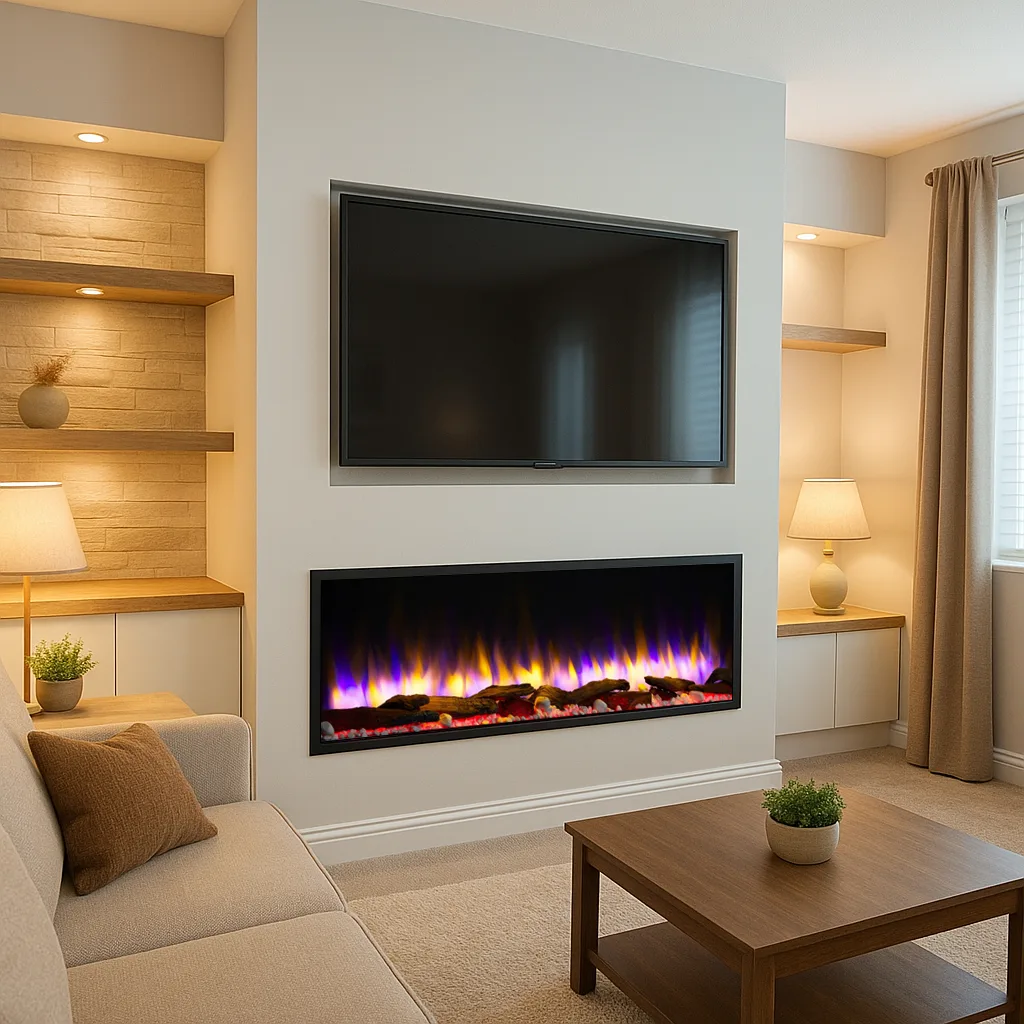
A slim electric fireplace media wall can give your living room a warm, modern look without taking up too much floor space. Instead of adding a bulky fireplace surround, the fire can sit neatly below the TV and become part of the wall itself.
This is a strong choice if you want:
· A modern media wall fireplace
· A clean TV and fire feature
· Simple installation
· Low maintenance heating
· A cosy focal point without losing space
The Importance of Proportion
Before thinking about materials, shelving or lighting, proportion needs to be resolved.
The relationship between the television and the fireplace defines everything that follows.
A fireplace that is too small beneath a large screen can feel incidental, almost decorative. One that is too large can overpower the composition. The aim is balance, a horizontal presence that supports the screen without competing with it.
Height is equally important. A television positioned too high may align visually with the design, but it becomes uncomfortable in everyday use. A well-considered media wall balances visual composition with practical comfort.
When the proportion is right, the rest of the design becomes significantly easier.
Why Simplicity Feels More Expensive
There is a natural temptation to add features. Shelving, display niches, layered lighting, and contrasting materials. Each addition feels like it enhances the design.
In practice, each addition increases visual noise.
The most successful media walls tend to be the simplest. A continuous surface, a single fireplace, a carefully positioned screen. If shelving is introduced, it should feel intentional and minimal. If lighting is used, it should support the atmosphere rather than draw attention to itself.
Complexity often reads as effort. Simplicity, when executed well, reads as confidence.
Materials That Age Well
Material choice has a lasting impact, not just visually, but in how the feature feels over time.
Matte finishes tend to be more forgiving than gloss. Soft plaster surfaces create a seamless effect that blends into the architecture of the room. Subtle timber detailing can introduce warmth without overwhelming the design.
Highly reflective or heavily patterned materials may feel striking initially, but they can date quickly. The goal is not to create something that demands attention immediately, but something that continues to feel right over time.
A media wall should not feel tied to a moment. It should feel considered beyond trends.
The Hidden Layer: Planning and Execution
What makes a media wall feel premium is often invisible.
Cabling must be concealed completely. Power points need to be placed precisely. Ventilation must be accounted for, particularly with certain fireplace types. Even small misalignments can disrupt the overall effect.
These details are not visible in the finished design, but they define it.
Rushed planning often leads to compromises that become permanent. A visible cable, a slightly misaligned edge or an awkwardly placed component can reduce the impact of an otherwise well-designed wall.
Execution is where intention becomes reality.
Understanding Cost Without Guesswork
Media walls vary significantly in cost because they are not a single product. They are a combination of structure, finish and installation.
A simple media wall with minimal detailing may remain within a modest range. More complex designs involving bespoke joinery, integrated lighting and premium finishes increase both material and labour costs.
In Leicester, most media walls fall somewhere between mid-range and premium installations, depending on the level of detail involved.
What matters is not achieving the lowest possible cost, but achieving a result that feels complete.
Where Most Media Wall Fireplace Goes Wrong
The most common issue is overdesign.
Too many materials are competing in one space. Too many shelves interrupt the flow. Lighting used as a feature rather than a subtle enhancement.
The result is a wall that feels busy rather than calm.
Another common mistake is misjudging scale. A fireplace that is too small, a screen that feels disconnected, or proportions that do not align with the room.
These are not technical failures. They are decisions that were not fully resolved at the start.
Creating Something That Feels Built In
The difference between a media wall that feels added on and one that feels built in is subtle but significant.
A built-in media wall feels like part of the architecture. The lines align with the room. The surfaces feel continuous. Nothing appears forced.
An added-on media wall feels like an installation placed against a wall, rather than integrated into it.
This distinction often comes down to restraint, proportion and finishing.
Visit a Fireplace Showroom Before Choosing
Photos can give you ideas, but seeing fireplaces in person helps you understand size, flame effect, finish and quality. Visiting a fireplace showroom in Leicester allows you to compare electric fires, media wall options, stoves, surrounds and installation styles before making a decision.
At Blue Oak Fireplaces, our team can help you choose a media wall fireplace that suits your room layout, budget and design style. Whether you want a simple TV wall with an electric fire or a bespoke media wall with shelving and lighting, the right advice can help you avoid costly design mistakes.
Final Thought
A media wall should not try to impress. It should try to resolve.
When it brings clarity to the room, when it simplifies rather than complicates, it achieves something more valuable than visual impact. It creates a space that feels easier to live in.
That is what ultimately defines a successful media wall, not how much it includes, but how little it needs to say.