
Introduction
Most people begin with images.
A marble surround, a media wall, a perfectly styled showroom display. Each looks convincing in isolation. But when those ideas are translated into a real home, something often shifts. The scale feels slightly off. The layout becomes awkward. The room, instead of feeling complete, feels assembled.
Searching for fireplace ideas Leicester is rarely about decoration alone. It is about resolution. It is about finding the element that allows a room to settle visually, practically and emotionally.
A well-placed fireplace does exactly that. It introduces a center of gravity. It gives the room a sense of intention.
Understanding the Room Before the Feature

Before choosing any style, it is worth stepping back and observing how the room already behaves.
Where does the eye naturally land when you walk in? Where do people sit without thinking about it? Does the television already dominate the space?
In many Leicester homes, particularly semi-detached properties, living rooms tend to be long rather than wide. This creates a subtle but important tension between furniture placement, circulation and focal points.
Introducing a fireplace into that environment without addressing the layout rarely improves the room. It simply adds another competing element.
The most successful spaces are not those with the most features, but those where each feature feels necessary.
Why Good Installations Feel Invisible
When a fireplace is installed well, it rarely draws attention to how it has been done.
There are no visible gaps. No awkward edges. No sense that the feature has been forced into place. Everything aligns. Everything feels intentional.
This is what makes a result feel effortless.
It is also why poor installation stands out so quickly. Even small misalignments or rushed finishes can disrupt the balance of the room.
Good installation is not about complexity. It is about precision.
The Most Common Points of Failure
Most installation issues do not come from technical limitations. They come from decisions that were not fully resolved early on.
A design chosen without considering the proportions of the room. A budget that focuses on the appliance but excludes finishing work. A timeline that underestimates how long proper installation takes.
These issues rarely appear at the start. They become visible once the project is underway, when changes are more difficult and more costly to make.
The result is often a compromise, not because the design was wrong, but because the process was incomplete.
The Fireplace Ideas That Work in Real Homes
There is no single best solution. What works depends entirely on the room. That said, certain approaches consistently deliver better results across Leicester homes.
A Media Wall That Feels Integrated
The popularity of media walls is not accidental.
They resolve a modern conflict. Televisions demand attention. Fireplaces traditionally did the same. When both are present, they often compete. A media wall removes that competition by bringing both into a single composition.
When it works, it feels architectural. The wall reads as one element rather than multiple parts.
The difference lies in restraint. One horizontal fireplace, proportionate to the screen above. Minimal shelving, if any. Materials that feel calm rather than decorative.
Where media walls fail is usually clear. Too many finishes. Too many interruptions. Too much effort to make the design interesting.
In reality, the most effective media walls are the quietest ones.
A Minimal Electric Fireplace, Properly Scaled
Not every space requires a built feature.
In newer homes or smaller living rooms, a simple electric fireplace can achieve more than a complex installation. The mistake is often in choosing something too small or too centred.
A narrow unit placed in the middle of a wall can feel temporary, almost like a placeholder. A wider unit, aligned more deliberately, anchors the space without demanding attention.
The shift is subtle, but it changes how the entire room is perceived.
Simplicity, when handled well, tends to feel more confident than complexity.
A Feature Wall That Supports the Room
In larger living areas, the fireplace can carry more presence.
This is where material becomes important. A soft plaster finish, a restrained stone effect or vertical timber detailing can introduce depth without overwhelming the space.
The fireplace sits within that surface, rather than competing against it.
The balance is delicate. Too little and the wall lacks presence. Too much and it becomes decorative rather than architectural.
The aim is not to create a focal point that demands attention, but one that holds the room quietly.
The Practical Value of a Corner Fireplace
Corner fireplaces are often overlooked, but in many Leicester homes they are one of the most intelligent solutions.
Where wall space is interrupted by windows, doors or circulation paths, a corner placement can create a focal point without disrupting the layout.
It allows furniture to be arranged more naturally. It also softens the geometry of the room, which can be particularly effective in compact spaces.
It is rarely the first option considered, but frequently one of the most effective once explored.
Where Most Projects Go Wrong
The majority of issues are not caused by poor products. They come from decisions made too early.
Choosing based on a photograph rather than a room. Underestimating scale. Adding features in an attempt to make the design feel premium. Failing to plan wiring and positioning before work begins.
Individually, these are small oversights. Together, they create a result that feels unsettled.
A fireplace ideas should bring clarity to a space. When it introduces complexity, something has gone wrong in the process.
Cost, Without Illusion
There is a tendency to think of a fireplace as a single purchase. In reality, it is part of a wider set of works.
An electric unit may be relatively modest in price, but once integrated into a wall, finished and decorated, the overall investment increases. A media wall involves structure, wiring, finishing and time.
In Leicester, most projects fall into three broad categories. A simple electric installation remains relatively contained. A well-executed media wall becomes a mid-level investment. Fully bespoke feature walls move higher, depending on materials and detail.
What matters is not the number itself, but whether the outcome feels resolved.
How to Make It Feel Premium Without Overdesigning
A premium result is rarely about adding more.
It is about refinement.
Clean alignment between elements. Consistent surfaces. Lighting that supports rather than competes. Proportions that feel natural to the room.
What often distinguishes a high-end result is not what has been included, but what has been left out.
Restraint is what allows a space to feel intentional.
Choosing Blue Oak Fireplaces as the Final Choice
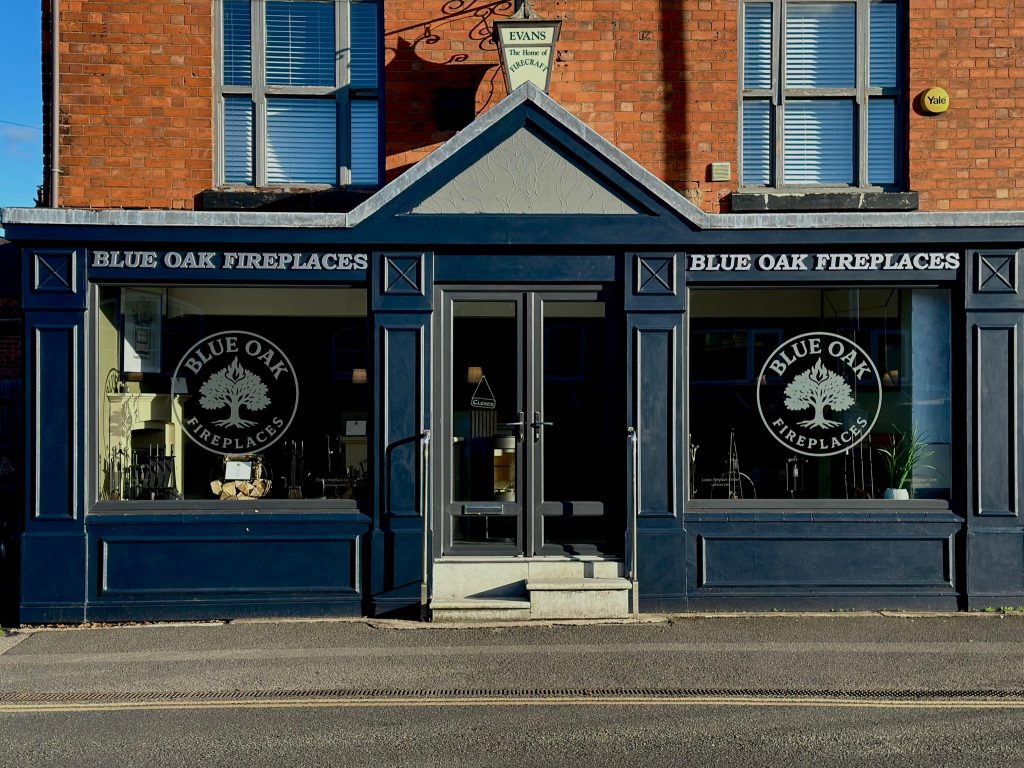
Seeing fireplace surrounds in person can make the decision much easier. Photos help with inspiration, but they do not always show true scale, depth, finish quality or flame effect. At Blue Oak Fireplaces, homeowners can explore fires, fireplaces, stoves, media walls and surrounds with expert advice from a team that understands both design and installation.
Blue Oak Fireplaces is based in Syston, Leicester, with a 3-storey showroom at 1159 Melton Road, Syston, Leicester, LE7 2JS. Visiting the showroom helps you compare materials, styles and fireplace types before committing to a design for your home
A Final Perspective
A fireplace ideas should not feel like something that has been added to a room. It should feel like something the room was always waiting for.
When scale, placement and material come together, the effect is subtle but undeniable. The space settles. It becomes easier to live in.
That is ultimately what people are searching for even if they begin with images.