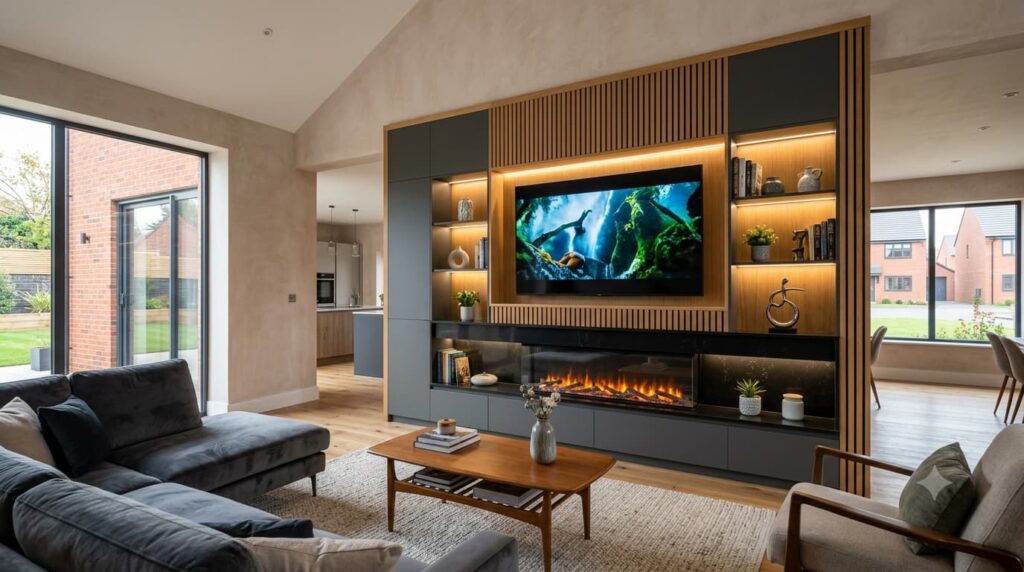
If you are planning a media wall and want a fireplace integrated beneath your television, the first question most homeowners ask is a sensible one: are media wall fireplaces safe for TVs? It is a fair concern. Televisions are expensive, heat and electronics are not natural friends, and the last thing you want is to spend thousands of pounds on a stunning media wall only to damage your screen within a year.
The reassuring answer is yes — a media wall fireplace can be completely safe for the TV above a fireplace, provided the right type of fire is chosen, the correct clearance distances are maintained, and the build is planned and installed properly from the outset. The problems that do arise almost always come down to one of three things: the wrong fire type, insufficient clearance between the fire and the TV, or a build that has not been designed with heat management in mind.
In this guide, Blue Oak Fireplaces walks you through everything you need to know — from how different fireplace types affect TV safety, to exact clearance requirements, structural build considerations, and the warning signs that your setup may be putting your television at risk.
Why Heat Is the Primary Concern
To understand why some media wall fireplace setups are safer than others, it helps to understand what heat actually does to a television.
Modern flat-screen televisions — whether OLED, QLED, or LED LCD — contain a range of components that are sensitive to sustained high temperatures. Circuit boards, capacitors, backlighting systems, and the display panel itself are all designed to operate within a specific ambient temperature range. Most major manufacturers including Samsung, LG, Sony, and Panasonic specify a maximum operating temperature of around 35 to 40 degrees Celsius.
When a TV is consistently exposed to temperatures above this threshold, the damage is not usually sudden or dramatic. It is gradual and cumulative. Capacitors degrade faster than they should. The LCD backlight dims prematurely. Circuit boards develop intermittent faults. The lifespan of an expensive television that should last ten years can be cut to four or five by sustained heat exposure that sits just slightly above the safe threshold.
The additional concern is warranty coverage. The terms and conditions of most major television manufacturers explicitly exclude heat damage caused by improper installation from their warranty coverage. If your TV fails and an engineer determines that heat damage from a fireplace below is the cause, your warranty claim is likely to be rejected regardless of the television’s age.
This is why heat management in a media wall is not just a comfort consideration. It is a financial one.
How Different Fireplace Types Affect TV Safety
Not all media wall fireplaces present the same level of risk to the TV above them. The type of fire you choose is the single most important factor in determining how safe your setup will be.
Electric Fires: The Safest Option for Media Walls
Electric fires are by far the safest type of fireplace to install in a media wall beneath a television, and this is not simply a marketing claim. There is a clear technical reason for it.
Electric fires produce no combustion. There are no real flames, no exhaust gases, and no radiant heat from burning fuel. The heat they produce comes entirely from an electric heating element — the same technology used in a fan heater — and in most modern media wall electric fires, that heat is directed forward into the room rather than upward toward the TV above.
This front-venting heat direction is the key distinction. When warm air is pushed forward and outward into the room, it dissipates into the living space rather than rising behind the television. The wall structure above the fire remains significantly cooler than it would with any combustion-based appliance.
Additionally, modern electric fires designed specifically for media wall installation include several built-in safety features that reduce risk further:
Overheat protection with automatic cut-out. If the internal temperature of the fire unit exceeds a safe threshold, the heating element shuts off automatically. This prevents the appliance from continuing to generate heat if airflow around it becomes restricted.
Flame-only mode. Every quality media wall electric fire allows you to run the LED flame effect without activating the heating element at all. This means you can enjoy the visual atmosphere of a glowing fire year-round — including on warm days when no additional heat is needed — without generating any heat whatsoever.
Thermostat control. Most models include a built-in thermostat that switches the heating element on and off automatically to maintain a target room temperature, rather than running continuously at full output.
The combination of forward-directed heat, automatic safety cut-outs, and the option to run without heat makes electric fires the straightforward choice for any homeowner concerned about TV safety in a media wall.
Gas Fires: Safe When Correctly Specified and Installed
Gas fires can be used in a media wall configuration, but they require more careful planning than electric fires from a heat management perspective.
Glass-fronted gas fires contain most of the radiant heat within the firebox, which prevents the intense thermal output you get from an open flame reaching the wall and TV above. However, the glass panel itself can reach temperatures of 70 to 80 degrees Celsius during operation, and convective heat still rises from the top of the fire unit.
A gas fire in a media wall requires a larger clearance distance between the top of the fire and the base of the TV than an electric fire does. It also requires careful attention to the heat outlet position and the ventilation design of the stud wall to prevent heat from accumulating in the void between the fire and the TV.
Gas fires also introduce a flue or balanced flue terminal into the media wall build, which adds complexity to the structural design and requires a Gas Safe registered engineer to carry out the connection and commissioning. The annual Gas Safe service obligation also applies.
None of this makes a gas fire in a media wall inherently unsafe for the TV above, but it does mean that the planning, specification, and installation need to be handled by an experienced team who understand exactly how heat behaves in this type of enclosed build. Our installation services team manages all of these considerations as part of every media wall project we undertake.
Wood-Burning Stoves: Not Suitable for a Standard Media Wall
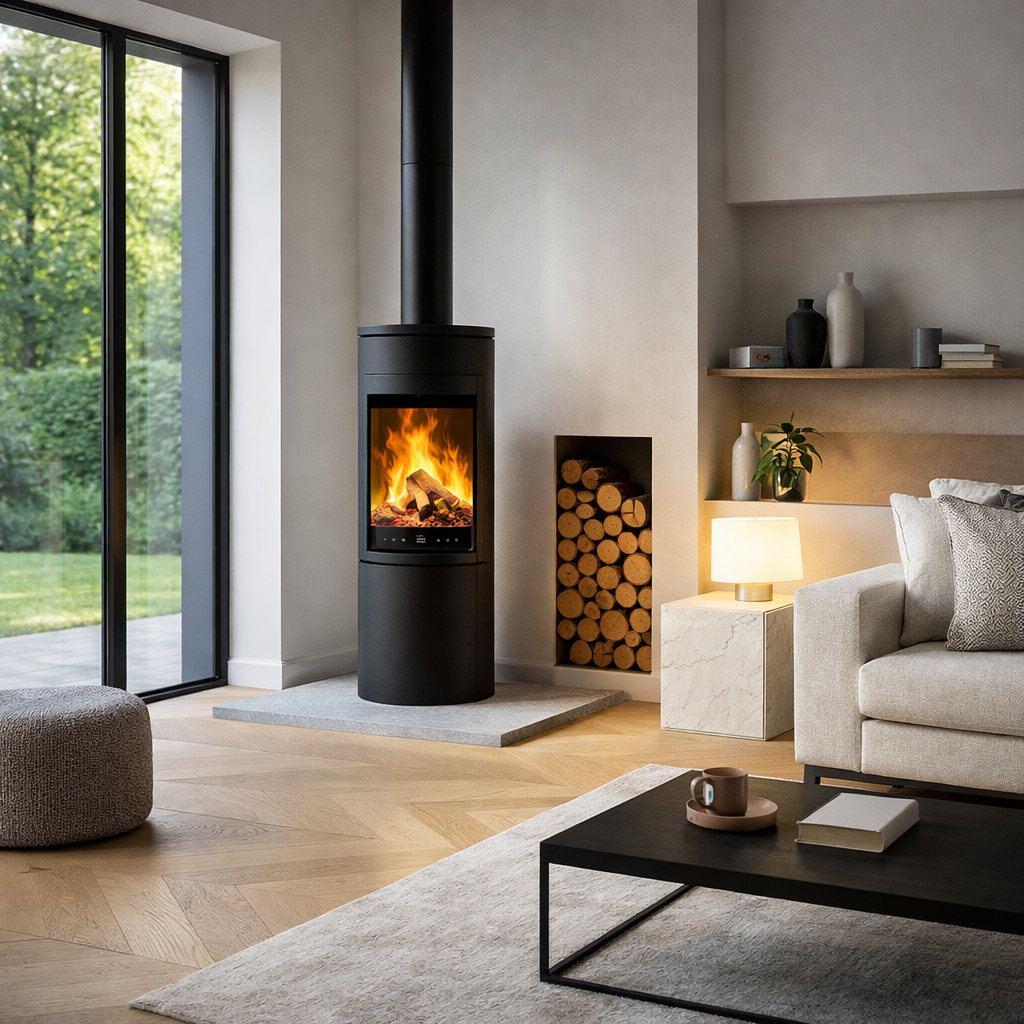
Wood-burning and multi-fuel stoves generate substantial radiant heat from their surfaces during operation. Stove surface temperatures regularly exceed 100 degrees Celsius, and unlike gas or electric fires, that heat cannot be controlled, directed, or redirected. It rises in a concentrated column from the top of the stove directly toward whatever is above it.
Placing a television above a wood-burning stove in a standard media wall configuration is not recommended. The heat output is simply incompatible with the operating temperature requirements of modern flat-screen televisions, and no clearance distance that makes the setup aesthetically functional is likely to be sufficient to keep the TV within a safe temperature range during normal operation.
If you love the look and feel of a wood-burning stove and want to incorporate a television into the same room, the better approach is to position them on different walls rather than in a combined media wall arrangement. You can explore the full range of stoves and electric fires available at Blue Oak to find the right solution for your room layout.
The Clearance Distance: How Much Space Does Your TV Need?
Clearance distance — the gap between the top of the fire and the bottom of the TV — is one of the most practically important specifications in any media wall design. Getting this right is non-negotiable.
For Electric Fires
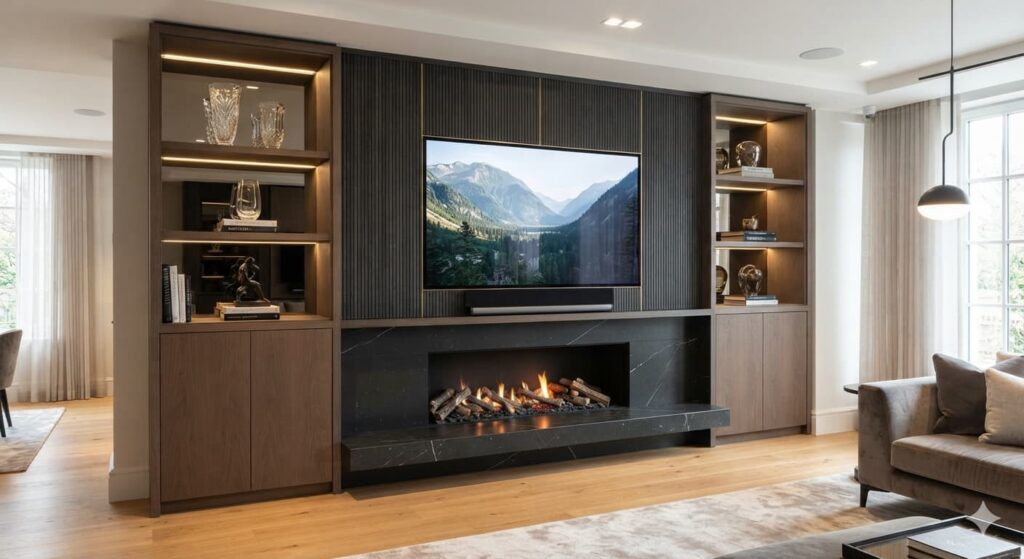
Most electric fire manufacturers specify a minimum clearance of 200mm to 300mm between the top of the fire opening and the base of the television. The widely cited guideline among installation professionals is a minimum of 300mm (approximately 12 inches), which provides a comfortable safety margin for most electric fire models.
Some front-venting electric fires designed specifically for media wall installation can operate with slightly reduced clearances, but these specifications are model-specific and must be confirmed in the individual product’s installation manual. Never assume a clearance that is not explicitly stated by the manufacturer.
The 300mm clearance guideline applies when the fire is being used with the heating element active. When running in flame-only mode with no heat output, the clearance requirement is effectively eliminated, as there is no warm air being generated.
For Gas Fires
Gas fires in a media wall configuration typically require a larger clearance distance, often in the range of 350mm to 500mm or more depending on the heat output of the specific model and its heat outlet design. Always defer to the manufacturer’s installation manual for the exact figure relevant to your chosen fire.
Why the Clearance Distance Matters Beyond the Numbers
It is important to understand that clearance distance alone does not guarantee TV safety if other aspects of the build are not correct. A 300mm gap with poor ventilation in the stud wall can still result in heat accumulating around the fire and rising toward the TV. A 300mm gap with a top-venting fire can allow warm air to build up in the enclosed recess above the fire.
The clearance distance works in conjunction with:
Ventilation within the stud wall. The void inside the media wall needs adequate airflow to prevent heat from accumulating. The fire’s installation manual will specify ventilation requirements that must be incorporated into the build design.
Heat outlet direction. A front-venting fire with a 300mm clearance is significantly safer than a top-venting fire with the same clearance. Both meet the minimum specification, but the thermal environment around the TV will be markedly different.
Build materials. The area immediately surrounding the fire opening in the media wall should use non-combustible or fire-rated board materials such as calcium silicate board rather than standard plasterboard. This provides additional protection against heat transfer into the surrounding wall structure.
TV Viewing Height: The Problem Nobody Talks About Enough
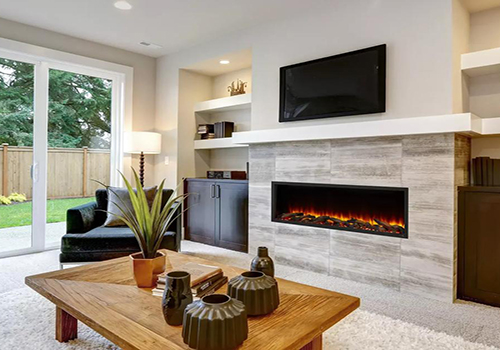
Heat safety is the primary technical concern with a TV above a fireplace, but there is a second issue that affects far more homeowners in practice: viewing comfort.
When a fireplace is incorporated into a media wall, there is often a temptation to raise the television higher than necessary to create clearance above the fire. This is sometimes driven by a genuine clearance requirement, but more often it is a design choice made without fully thinking through the ergonomic implications.
The comfortable seated eye level for television viewing is typically with the centre of the screen at approximately 100 to 110cm from the floor, depending on sofa height and the distance between the seating and the screen. When the TV is mounted significantly higher than this — which can happen when it is positioned well above a tall fireplace recess — viewers must tilt their heads upward to watch, causing neck strain during prolonged viewing.
The solution is not to compromise on fire clearance to bring the TV lower. Instead, the media wall should be designed from the outset with both the fire height and the TV height planned together. Key considerations include:
Choosing a fire with an appropriate height. A taller fire recess pushes the TV higher. Choosing a landscape electric fire with a proportionate height for the room keeps the TV at a comfortable viewing level while maintaining the correct clearance.
Using a tilting or articulating TV wall mount. A mount that allows the TV to tilt downward can compensate for a slightly elevated mounting position, directing the screen angle toward the viewer rather than presenting a flat-on view from above.
Positioning a shelf between the fire and the TV. In some media wall designs, a shallow shelf between the fire opening and the TV base serves double duty: it acts as a subtle heat break between the fire and the TV, and it provides a useful surface for a soundbar, remote controls, or decorative items. Where a shelf is used, the manufacturer’s clearance requirements should still be measured from the top of the fire to the underside of the shelf, and then from the shelf to the base of the TV.
What the Build Materials Say About Safety
A media wall is not just a decorative feature. It is a structure, and the materials used in its construction have a direct bearing on how safely the fire and television coexist within it.
Calcium Silicate Board
The zone immediately surrounding the fire opening should be lined with calcium silicate board, which is a non-combustible, fire-resistant material specifically designed for use around high-heat appliances. It is a standard requirement in properly specified media wall builds and acts as a thermal barrier between the fire body and the surrounding plasterboard structure.
Standard plasterboard alone is not appropriate for direct contact with or close proximity to the fire opening. It is combustible under sustained heat exposure and can degrade over time in a way that calcium silicate board will not.
Fire-Rated Plasterboard
Beyond the immediately adjacent zone, fire-rated plasterboard (typically 12.5mm or 15mm Type F or Type X boards) should be used throughout the media wall structure. This provides a meaningful improvement in fire resistance compared to standard boards while remaining straightforward to finish and decorate.
Steel Studwork
Steel studwork is preferred over timber for media wall construction because it is non-combustible and does not shrink or warp over time with heat exposure in the way that timber can. A steel-framed stud wall around a fireplace provides a more stable and thermally appropriate structure for long-term performance.
Our media wall installation team specifies and builds all of these elements as standard in every project we undertake, ensuring the structure is as safe as it is visually impressive.
How to Test Whether Your TV Position Is Safe
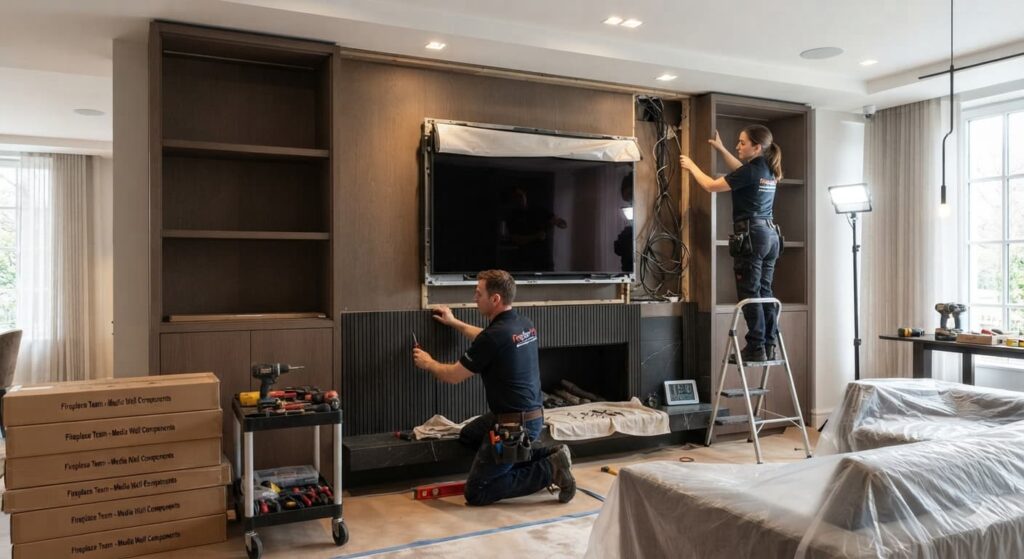
If you are installing a new fire in an existing media wall, or you have recently had a fire installed and want to confirm your TV position is safe, a simple temperature test is a worthwhile step.
Before mounting the TV, tape a thermometer or a temperature probe to the wall at the exact point where the centre of the TV screen will sit. Run the fire at full heat output for two to three hours — a typical extended period of evening use — and then check the recorded temperature.
If the wall temperature at that point remains below 35 to 40 degrees Celsius, the position is within the operating temperature range for most televisions. If the temperature exceeds this threshold, the TV mounting position should be raised, the ventilation within the stud wall should be reviewed, or the fire type should be reconsidered.
A non-contact infrared thermometer, available inexpensively from most hardware stores, makes this test straightforward to carry out.
Red Flags That Your Media Wall Setup May Not Be Safe
Whether you are assessing an existing installation or evaluating a proposed design, these warning signs indicate that the TV may be at risk:
The fire’s installation manual was not consulted before the wall was built. If the recess depth, clearance distances, and ventilation requirements in the manufacturer’s manual were not followed during the build, the setup may not meet the fire’s minimum safety specifications regardless of how it looks.
There is no visible ventilation provision in the stud wall. The fire’s installation manual will specify ventilation requirements for the recess. If these have not been incorporated into the build, heat can accumulate within the wall void and rise toward the TV.
The TV centre is significantly above seated eye level. While not a safety issue in itself, a TV mounted uncomfortably high is often a sign that the fire and TV heights were not planned together, which can indicate other planning oversights in the build.
The fire is top-venting and the TV clearance is minimal. Top-venting fires in media walls with tight clearances above the fire create the highest risk of heat accumulation around the TV.
The area around the fire opening uses standard plasterboard with no calcium silicate lining. This indicates the build has not followed standard fire protection specifications for the materials adjacent to the appliance.
If you have an existing media wall and are concerned about any of these issues, our services team can carry out an inspection and advise on any remedial work required.
Does a Media Wall Fireplace Require Planning Permission?
This is a question many homeowners ask when considering a media wall installation. The straightforward answer for standard internal media walls is no. A media wall is an internal structural feature, not an external alteration, and does not require planning permission in most cases.
However, any new electrical work associated with the installation — including new power sockets, dedicated circuits, or first-fix wiring — must comply with UK Building Regulations Part P for domestic electrical installations. Where new circuits are created, the work should be carried out by a qualified electrician who can certify the installation.
For media walls incorporating gas fires, the gas connection must be carried out by a Gas Safe registered engineer, who will issue the relevant certificate on completion.
Our team manages all regulatory requirements as part of our full media wall service, so you do not need to coordinate multiple contractors or navigate compliance requirements independently. You can learn more about what is involved in the full process in our guide to what is included in a professional fireplace installation.
Choosing the Right Electric Fire for Your Media Wall: A Safety-First Summary
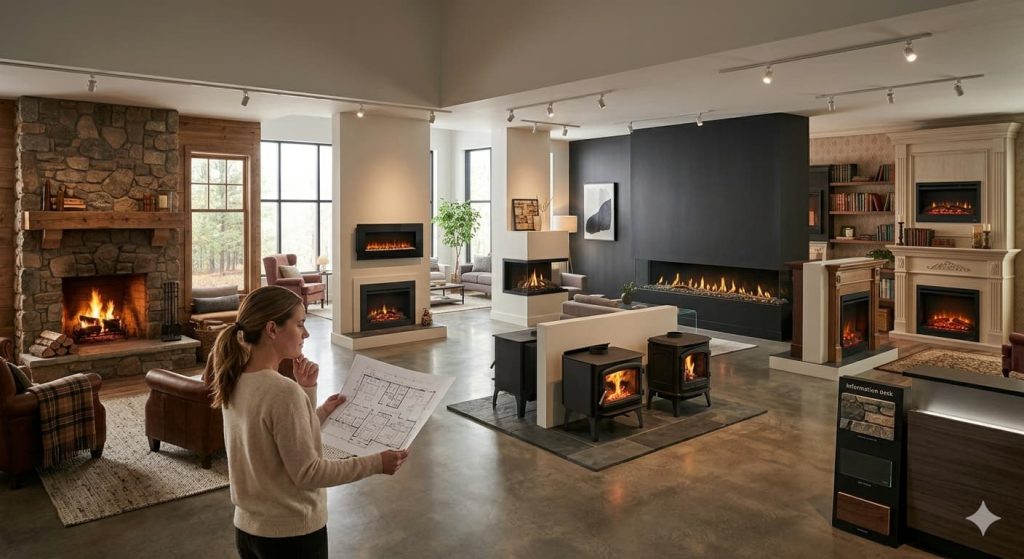
If you are building a new media wall and want to ensure your TV is as safe as possible above the fireplace, the key decisions are:
Choose an electric fire designed specifically for media wall installation. These models are built with the TV-above configuration in mind. They have appropriate recess depths, front-directed heat outlets, overheat protection, and flame-only modes that make them the safest possible partner for a television in a shared wall.
Confirm the clearance requirement before the wall is built. Check the installation manual of your chosen fire for the minimum clearance distance between the top of the fire opening and the base of the TV. Design the media wall layout around this figure, not around an assumed number.
Specify the correct build materials. Calcium silicate board around the fire opening, fire-rated plasterboard throughout the wall, and steel studwork are the standard specification for a safe and durable media wall build.
Plan the TV height and fire height together. Ensure the TV will sit at a comfortable viewing height for seated viewers once the clearance above the fire is applied. The centre of the screen should ideally be at approximately 100 to 110cm from the floor.
Have the installation carried out by experienced professionals. A media wall that looks stunning but has been built without following the fire manufacturer’s specifications is both a safety risk and a potential source of significant expense if things go wrong.
At Blue Oak Fireplaces, our media wall projects are designed and installed by an experienced team that handles everything from the initial design consultation through to the completed, commissioned installation. You can see examples of finished projects in our gallery and read about real builds in our case studies.
To get started, visit our showroom in Syston, Leicester, or contact us to arrange a free design consultation and home survey.
Frequently Asked Questions
Are media wall fireplaces safe for TVs?
Yes, media wall fireplaces are safe for TVs when the correct fire type is chosen, the manufacturer’s clearance distances are followed, and the build is constructed using appropriate fire-rated materials. Electric fires are the safest option because they produce no combustion, direct heat forward into the room rather than upward, and include safety features such as automatic overheat cut-outs and flame-only modes. Gas fires can also be used safely in a media wall with proper planning and professional installation. Wood-burning stoves are not recommended in a combined media wall configuration with a TV due to their uncontrolled high-temperature heat output.
How much clearance does a TV need above a media wall electric fire?
Most electric fire manufacturers recommend a minimum clearance of 200mm to 300mm between the top of the fire opening and the base of the TV. The widely accepted professional guideline is 300mm, or approximately 12 inches, which provides a safe buffer for most electric fire models during normal heated operation. The exact minimum clearance for your specific fire model will be stated in its installation manual, and this figure should always take precedence over general guidelines. When running an electric fire in flame-only mode with no heat output, the clearance requirement is effectively removed as no warm air is being generated.
Can a media wall fireplace damage my TV?
A media wall fireplace can damage a TV if the wrong fire type is used, insufficient clearance is left between the fire and the TV, or the build is not designed with proper ventilation and fire-rated materials. Most major TV manufacturers specify a maximum safe operating temperature of around 35 to 40 degrees Celsius. Sustained exposure to temperatures above this threshold can accelerate the degradation of internal components, shorten the TV’s lifespan, and may void the manufacturer’s warranty. An electric fire that is correctly specified, properly installed with adequate clearance, and built into a well-ventilated stud wall using appropriate materials poses minimal risk to the TV above a fireplace.
Does mounting a TV above a fireplace void the TV warranty?
Many major television manufacturers including Samsung, LG, Sony, and Panasonic explicitly exclude heat damage from improper installation from their warranty coverage. If a TV fails and the cause is determined to be heat damage from a fire installed below it, the warranty claim is likely to be declined. This is not a reason to avoid combining a TV and fireplace in a media wall — it is a reason to ensure the installation is done correctly, with the right fire type, appropriate clearance distances, and proper build materials. A correctly installed electric fire in a media wall presents minimal heat risk to the TV above a fireplace under normal operating conditions.
What type of fireplace is safest to put under a TV?
An electric fire is the safest type of fireplace to install beneath a TV in a media wall. Electric fires produce no combustion, generate heat through a controllable electric element rather than burning fuel, and in most media wall-specific models direct that heat forward into the room rather than upward toward the TV. They also include overheat protection with automatic cut-out and offer a flame-only mode that allows the visual effect to be enjoyed with zero heat output. Gas fires are the second safest option when correctly installed with adequate clearance and professional Gas Safe commissioning. Wood-burning stoves are not suitable for a combined TV and fireplace media wall arrangement.
Can I put a TV above a gas fire in a media wall?
Yes, it is possible to install a TV above a gas fire in a media wall, but it requires more careful planning and larger clearance distances than an electric fire installation. Glass-fronted gas fires contain most radiant heat within the firebox, but the glass panel can reach high temperatures and convective heat still rises from the top of the unit. A gas fire in a media wall requires a minimum clearance of approximately 350mm to 500mm or more between the fire and the TV depending on the specific model, adequate ventilation within the stud wall, and professional installation by a Gas Safe registered engineer. The exact clearance and ventilation requirements for your chosen gas fire model will be specified in its installation manual.
Is it safe to run a media wall electric fire with the heat on while the TV is on?
Yes, running a media wall electric fire with the heating element active while the TV is on above it is safe, provided the correct clearance distance has been maintained between the fire and the TV, the stud wall has been built with appropriate ventilation, and the fire is a front-venting model designed for media wall installation. The electric fire’s forward-directed heat will warm the room without creating a concentrated column of heat rising toward the TV. If you want to be absolutely certain there is no heat risk at all, running the fire in flame-only mode eliminates any thermal output entirely while still providing the visual atmosphere of a lit fire.
What wall materials should be used around a fireplace in a media wall?
The zone immediately surrounding the fire opening in a media wall should be lined with calcium silicate board, which is a non-combustible, fire-resistant material designed for use around high-heat appliances. Standard plasterboard should not be used in direct proximity to the fire opening as it can degrade under sustained heat exposure. Throughout the rest of the media wall structure, fire-rated plasterboard provides an appropriate level of fire resistance while remaining straightforward to finish and decorate. Steel studwork is preferred over timber for the frame itself because it is non-combustible and dimensionally stable under heat exposure. These material specifications are standard practice in professionally built media walls.
How do I know if my TV is getting too hot from the fireplace below?
There are several indicators that a TV mounted above a fireplace may be experiencing excessive heat. Persistent picture quality issues such as unexpected dimming, colour distortion, or backlight irregularity can indicate thermal stress on the display components. The TV running noticeably hot to the touch on the base or rear during normal use is another sign. Unexpected shut-downs or reboots can occur when the TV’s internal thermal protection systems activate in response to elevated temperatures. The most direct way to assess the situation is to use a non-contact infrared thermometer to measure the wall temperature at the TV mounting position after the fire has been running at full heat for two to three hours. A reading consistently above 35 to 40 degrees Celsius indicates the clearance or ventilation needs to be reviewed.
Does planning permission need to be obtained for a media wall with a fireplace?
Planning permission is not required for a standard internal media wall installation in most cases, as it is an internal feature rather than an external alteration. However, any new electrical work associated with the build must comply with UK Building Regulations Part P for domestic electrical installations. New circuits or consumer unit connections should be carried out by a qualified electrician who can certify the work. For media walls incorporating gas fires, the gas connection must be completed and certified by a Gas Safe registered engineer. Your installation team should handle all compliance requirements as part of the project, ensuring everything is signed off correctly before use. For a full breakdown of what compliance looks like for different fire types, our guide to what is included in a professional fireplace installation provides a detailed walkthrough.
What is the ideal TV height above a media wall fireplace?
The ideal TV height in a media wall with an integrated fireplace is one that places the centre of the screen at approximately 100 to 110cm from the floor when viewed from a seated position. This corresponds to roughly seated eye level for most adults on a standard sofa, and it is the viewing height that minimises neck strain during extended television use. The challenge in a media wall design is ensuring that the required clearance above the fire still allows the TV to sit at this comfortable height. This is best achieved by planning the fire height and TV height together at the design stage, choosing a fire with proportionate dimensions for the room, and using a tilting wall mount where a slight angular adjustment can compensate for a marginally elevated mounting position.
Blue Oak Fireplaces serves homeowners across Leicester, Syston, and the wider East Midlands. Visit our showroom at 1159 Melton Road, Syston, LE7 2JS, or call us on 0116 373 4193 to arrange your free design consultation.